ClaviCologne 2018 Results Announced
A total of 76 participants from 34 countries gathered to showcase their skills, talent, and performance abilities. The festival included representatives from Austria, Azerbaijan, Albania, Armenia, Belarus, Belgium, the United Kingdom, Venezuela, Germany, Israel, Ireland, Italy, Canada, China, Colombia, Lithuania, Macedonia, Moldova, the Netherlands, Norway, Poland, Portugal, Russia, Romania, Serbia, the USA, Uzbekistan, Finland, France, Croatia, Switzerland, Sweden, South Korea, Japan, and more.
The five festival days were packed with a wide variety of events. The festival opened with a solo concert by young pianist Elizaveta Ivanova, and each day brought with it new surprises, with a significant part of the festival being the masterclasses that were held by world-renowned piano pedagogues and professors. These included amongst them Professor Dmitry Bashkirov (Moscow State Conservatory, Russia), Professor Ilya Sheps (Aachen Conservatory, Germany), Professor Jan Jiracek von Arnim (University of Music and Performing Arts, Austria), Professor Grigory Gruzman (Franz Liszt Music University, Germany), Professor Zhe Tang (Shanghai Conservatory, China), Professor Vladimir Ovchinnikov (Moscow State Conservatory, Russia), Aquiles Del Vigne (Buenos Aires, Argentina), and Professor Geza Lücker (Cologne University of Music and Dance, Germany).
Two young Maltese students also received lessons from these distinguished professors; their trip to the festival was sponsored by the European Foundation for Support of Culture.
A young Maltese pianist and composer shared his impressions:
“The professors I worked with were very distinguished — Zhe Tang, Vladimir Ovchinnikov, Ilya Sheps… Their teaching methods were different — some advised to touch the keys gently rather than strike them, others insisted on exact reading of the piece, and some simply spoke poetically, and you played according to what you heard. I played Wagner, Liszt, a Beethoven sonata, and also several pieces I wrote myself. The professors gave me many tips, such as how to work on composition, how to interpret it, how to understand the composer’s intention, how to produce sound, and even how to behave appropriately on stage. The atmosphere of the masterclasses was very inspiring: imagine one class playing Liszt while from another came Beethoven… you are simply filled with melodies! There were also many concerts, and I happily watched La Traviata and Don Giovanni.”
Another young Maltese pianist echoed his sentiments:
“Thanks to the European Foundation for Support of Culture for the opportunity to take part in the ClaviCologne festival! It was truly an unforgettable week, full of inspiring masterclasses and concerts. I studied with professors Ovchinnikov, Sheps, and Tang. I learned a lot from them because they shared many valuable observations about my repertoire. The suggestions they gave, along with advice on how to work on sound quality, changed my approach to playing. I immersed myself completely in the festival, spending as much time as possible attending student concerts and masterclasses. I also observed masterclasses by Professor Dmitry Bashkirov, Professor Jan Jiracek von Arnim, Professor Grigory Gruzman, and Professor Aquiles Del Vigne, where I also learned a lot of important information.”
The concerts in Germany and the Netherlands were a wonderful experience, with the young musicians being able to showcase the works they had worked on during the masterclasses.
Moreover, within the framework of the festival, the final preliminary event of the “11 Ways to Malta” series was held. Since July 2017, ten musical competitions have been held in ten cities across Europe and Asia, and now, the ClaviCologne event has become the eleventh step towards the final Grand Finale in Malta.
In the younger age category, the jury included Professor Herbert Herz (Executive Director of the Aachen branch of the Cologne Music Academy, Germany), Oleg Krimer (German pianist and pedagogue), Pedro Obiera (music journalist, Germany), Gella Westendorf (pianist and pedagogue, Germany), and Alexander Yakonyuk (violinist and laureate of international piano competitions, Belarus).
In the senior age category, the jury consisted of Alexander Mndoyants (Professor, Moscow State Conservatory, Russia), Georg Friedrich Schenk (Professor, Hochschule für Musik und Theater “Felix Mendelssohn Bartholdy” Leipzig, Germany), Cordelia Heef (Professor of Piano and Chamber Music, Mozarteum University Salzburg, Austria), Sergey Edelman (Professor, Royal Conservatoire Antwerp, Belgium), and Nareh Argamanyan (renowned pianist, Austria).
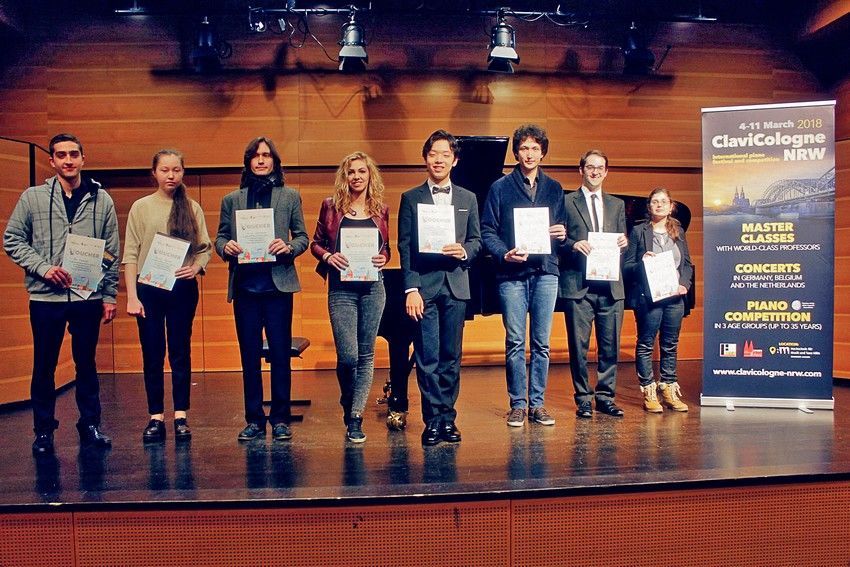
Competitions were held across three age groups: up to 13 years, 14–17 years, and 18–35 years. In the end, five pianists earned places in the final, qualifying for the Malta International Music Festival:
- Alexander Bernstein (USA–Ireland)
- Li Hook (South Korea)
- Tina Ronkin (Israel)
- Marcel Tadokoro (France)
- Georgiy Voylochnikov (Russia–Germany)
